The refund window attaches to this desk
Buying here puts your order with the order desk and applies the 60-day window. An order placed somewhere else is somebody else's policy and we cannot help with it.
Sodatide is a dietary supplement capsule for daily digestive and metabolic support.
Use case: Adults take one vegetarian capsule a day with an 8 oz glass of water to support digestion, appetite control and satiety.
How it works: Chicory root inulin and potato resistant starch are prebiotic fibers fermented in the gut, and a 36 mg blend adds B. infantis, C. butyricum and A. muciniphila.


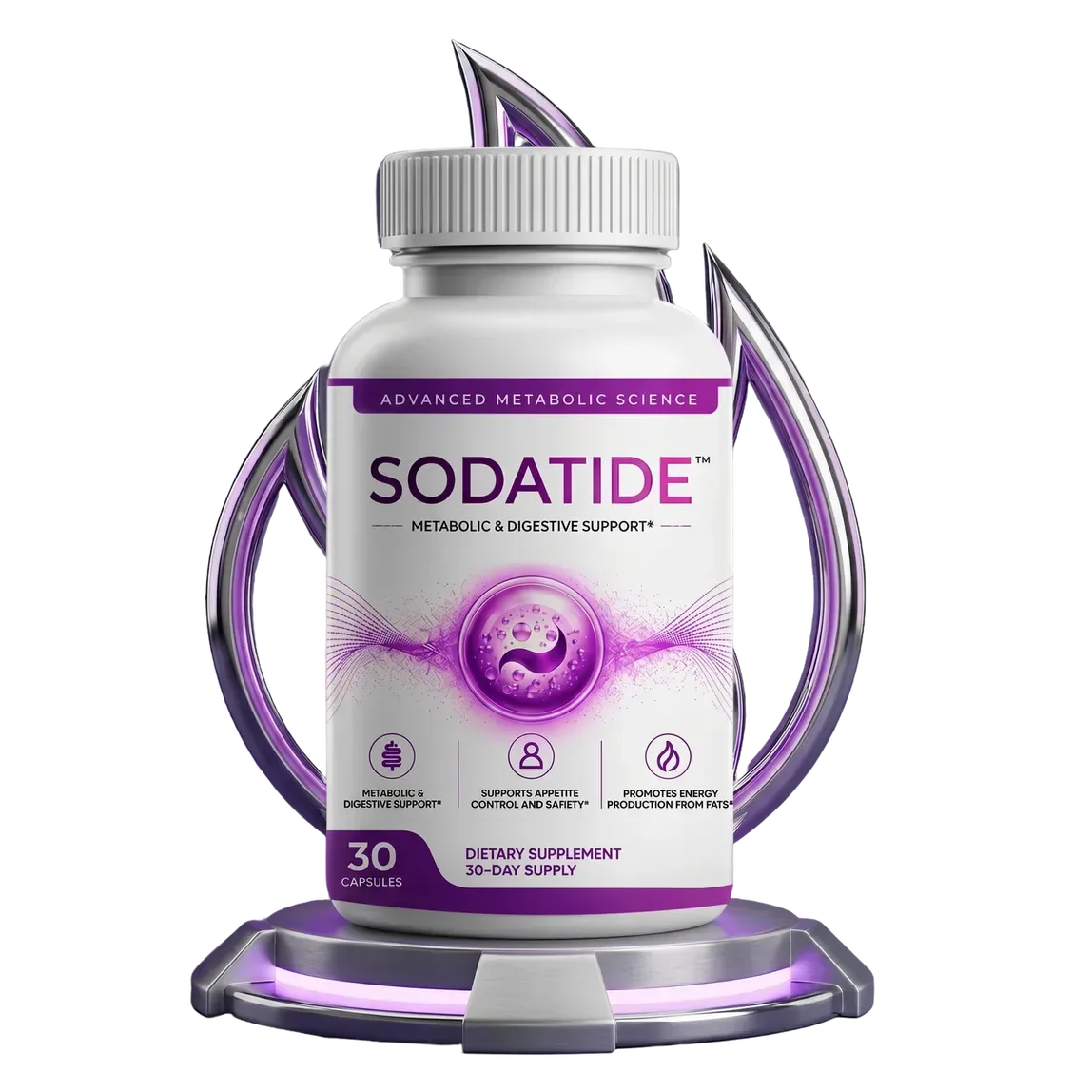


Sodatide is a vegetarian capsule taken once a day, 30 to a bottle. Each capsule holds 347 mg of declared ingredients. No price is published, so the checkout shows it, and a 60-day money-back guarantee runs from the purchase date.
Every line below is read off the printed label or the brief we were given. Where nothing was published, the row says so rather than guessing.
| Detail | What the label and the seller say |
|---|---|
| Product | Sodatide, a metabolic and digestive supplement in vegetarian capsules |
| Front of bottle | Advanced Metabolic Science · SODATIDE · Metabolic & Digestive Support · 30 Capsules · 30-Day Supply |
| Supplement Facts panel | Complete. Serving size, servings per container, an amount for every declared ingredient and the correct dagger footnote |
| Serving | One capsule daily with an 8 oz glass of water |
| Servings per bottle | 30. A bottle is exactly thirty days, and the front says so |
| Declared ingredients | Three. Inulin 211 mg, resistant starch 100 mg, probiotic blend 36 mg |
| Whole capsule | 347 mg of declared ingredients |
| Proprietary blends | One. The 36 mg Probiotic Blend, holding three organisms |
| Live count (CFU) | Not printed anywhere |
| Strain designations | None. Genus and species only |
| Capsule shell | Hypromellose, printed as a vegetarian capsule |
| Other ingredients | Four: hypromellose, microcrystalline cellulose, magnesium stearate, silica |
| Caution panel | Printed, and properly worded. Pregnancy, nursing, under-18s, known medical conditions |
| Storage | Three instructions that disagree — refrigerate, avoid humidity, store cool and dry |
| Distributed by | Instituto Experience, Lakeland FL, 33804, with a phone number and an email |
| Made in USA | Qualified, and correctly so: made in the USA with globally sourced ingredients |
| Price | Not published to us. The checkout is the only figure |
| Guarantee | 60 days from purchase. Two supplied graphics agree on it |
| Shipping | Ships from the United States. Cost and speed: not published |
| Order desk | The order desk, with your order ID |
| Sold by | Sodatidedaily, a USA Authorized Sodatide Retailer |
Sodatide is a dietary supplement capsule for metabolic and digestive support. One capsule a day holds 211 mg chicory root inulin, 100 mg potato resistant starch and a 36 mg probiotic blend of three named organisms.
Sodatide is one capsule a day carrying 347 milligrams of declared ingredients: 211 mg of chicory root inulin, 100 mg of potato resistant starch, and a 36 mg Probiotic Blend holding Bifidobacterium infantis, Clostridium butyricum and Akkermansia muciniphila. The panel is built properly — serving size, servings per container, an amount for every declared ingredient, the correct footnote, a full other-ingredients line, a real caution block and a complete distributor address. The amounts are small next to the published trials, which mostly gave grams of fibre a day, and the probiotic blend names its organisms by species without a strain designation or a live count. The sections below set each figure beside the research it can be compared with.
You order Sodatide through the Order Now button on this page, which goes to the order desk. The 60-day money-back guarantee applies to orders placed here, and the checkout shows the price, since none is published on the site.
Ordering here puts your order with the order desk and applies the 60-day window to it. Price is whatever the checkout prints; we publish no figure we have not seen.
One Sodatide capsule declares 211 mg of chicory root inulin, 100 mg of potato resistant starch and a 36 mg probiotic blend. Together that is 347 mg. Research on these ingredients is written in grams, so the capsule amounts are small by comparison.
This is the whole argument of the site, and it takes four paragraphs.
The panel declares three things. Chicory root inulin, 211 mg. Potato resistant starch, 100 mg. Probiotic Blend, 36 mg. Added up, that is 347 milligrams, which is the entire declared contents of one serving.
Now the research. A twelve-week randomised trial gave 45 grams a day of high-amylose maize resistant starch to 68 adults with prediabetes. Its conclusion, in its own words: “RS2 supplementation did not increase satiety or reduce appetite and food intake in adults with prediabetes.” It also found “no effect on subjective measures of appetite” and “no effects… on appetite-related gut hormones”.
Forty-five grams is 450 times the 100 milligrams in this capsule. The front of this bottle says Supports Appetite Control And Satiety.
The inulin is the same shape of problem with a smaller multiplier. A systematic review of inulin-type fructans in adults covering fifteen randomised trials describes a trial using 8 grams a day — about 38 times what is here — and reports that “five RCTs found no effect of ITF supplementation on appetite sensations” and “eleven RCTs found no effect… on daily energy intake”. On body weight it is gentler: of three trials measuring weight, two found a significant reduction, and the review’s conclusion is deliberately narrow — “limited data suggest that long-term administration of ITF may contribute to weight reduction”.
None of that is a claim that this product does nothing. It is a statement about the distance between what is in the capsule and what anybody has tested, and that distance is the largest this desk has measured on any product.
Because two of the three amounts are printed. A label that hid 211 and 100 inside a blend would have escaped this entire section. The one ingredient we cannot do arithmetic on is the one that is inside a blend — which is exactly the point of the next few sections.
Studied doses are far larger than one capsule. One trial used 8 grams of inulin a day, about 38 times the 211 mg here. The satiety trial gave 45 grams of resistant starch a day, about 450 times the 100 mg here.
Pick an ingredient. The figure is simply the dose the research used divided by the amount this label prints. It is not a recommendation; it is a way of picturing the gap in a unit anybody understands.
The label says one capsule a day. These figures are simply the studied dose divided by the printed amount — they are not a recommendation, and taking handfuls of capsules is not one either. They exist to show the size of the gap in a unit anybody can picture.
The Sodatide label lists three declared ingredients with amounts: inulin 211 mg, resistant starch 100 mg and a 36 mg probiotic blend. Daily Value is not established for any of them. The label also prints the suggested use and a caution panel.

Sodatide is a dietary supplement sold as vegetarian capsules, 30 to a bottle. The front of the bottle says Metabolic and Digestive Support. This site, Sodatidedaily, is a USA Authorized Sodatide Retailer, not the maker.

A dietary supplement in hypromellose capsules, thirty to a bottle. The instruction is short and specific: as a dietary supplement, take one (1) capsule daily with an 8 oz. glass of water. Refrigerate for optimal quality.
One capsule is one serving and there are thirty servings in a bottle, so a bottle is exactly thirty days — and the front of the label says 30-DAY SUPPLY rather than making you work it out. Every amount on the panel is what one capsule delivers.
The formula is two prebiotic fibres and one probiotic blend. The fibres are chicory root inulin, printed with its species and plant part, and potato resistant starch, printed with its plant part. The blend holds three organisms: Bifidobacterium infantis, Clostridium butyricum and Akkermansia muciniphila.
That pairing is a reasonable idea on paper. Prebiotic fibres are the substrate that probiotic organisms ferment, so putting the two in one capsule is a coherent formulation choice rather than a random assortment. The question this site keeps returning to is not whether the idea is sound. It is whether 347 milligrams of it is enough to matter.
Orders placed here go to the order desk, and the 60-day refund window attaches to them. The desk can look up your order ID. An order placed somewhere else falls under that seller's own policy, which this desk cannot change.
Three practical reasons, none of them a claim about the product.
Buying here puts your order with the order desk and applies the 60-day window. An order placed somewhere else is somebody else's policy and we cannot help with it.
Every printed amount set beside the dose the research used, including the 450-fold comparison the brand would rather you did not make. It is on this page, not behind a link.
No CFU count, no strain designations, no individual amounts inside the blend, and three storage instructions that contradict each other. All of it is on the same page as the buy button.
Read the serving size first, then each amount, then the probiotic blend. Three of the six lines on this panel are done properly, and three are not done at all, such as strain names and a live cell count.
Tab through them. Three of the six are things this label does properly, and three are things it does not do at all.
As a dietary supplement, take one (1) capsule daily with an 8 oz. glass of water. Refrigerate for optimal quality.
One capsule is one serving and there are thirty in a bottle, so a bottle is exactly thirty days and the front of the label says so: 30-DAY SUPPLY. Every amount on the panel is what one capsule delivers.
211 plus 100 plus 36. That is the entire declared contents of one serving, before the shell and the excipients.
It is worth holding onto, because the research these three ingredients come from is measured in grams. Three hundred and forty-seven milligrams is about a third of a gram.
Probiotics are dosed in colony-forming units, not milligrams. There is no CFU figure on this label, on the listing, or anywhere in the material we were given.
ISAPP's consumer guidance says responsible manufacturers list the genus, species and strain, and the potency to expect through the end of shelf life. This label gives genus and species for three organisms and a combined weight. A weight is not a potency.
Bifidobacterium infantis, Clostridium butyricum, Akkermansia muciniphila. Three genus-and-species names and not one strain identifier.
That matters because probiotic evidence is strain-specific. NCCIH puts it plainly: if a specific kind of an organism helps, “that doesn't necessarily mean that another kind… would do the same thing”.
Hypromellose (vegetarian capsule), microcrystalline cellulose, magnesium stearate, silica.
All four are ordinary and all four are disclosed, which is how it should be. The shell being hypromellose is what makes the vegetarian mark checkable. The other three are what make the 100% Natural Ingredients roundel a stretch.
On one panel: Refrigerate for optimal quality. Then: STORAGE: Keep away from heat, light, and humidity to preserve freshness. Then: STORE IN A COOL, DRY PLACE.
A refrigerator is cool. It is not dry, and it is not free of humidity. Three instructions, printed within a few centimetres of each other, that a reader cannot follow all at once.
Chicory root inulin is 211 mg, potato resistant starch is 100 mg and the probiotic blend is 36 mg per serving. Each shows a dagger instead of a percent Daily Value. The three organisms inside the blend have no amounts of their own.
Three declared ingredients with amounts, then the three organisms named inside the blend with no amounts of their own.
| As printed on the panel | Amount per 2-capsule serving | % Daily Value |
|---|---|---|
| Chicory Root Inulin (Cichorium intybus) (root) | 211 mg | † |
| Potato [Resistant Starch] (tuber) | 100 mg | † |
| Probiotic Blend | 36 mg | † |
| Bifidobacterium infantis | inside the 36 mg blend | Daily Value not established |
| Clostridium butyricum | inside the 36 mg blend | Daily Value not established |
| Akkermansia muciniphila | inside the 36 mg blend | Daily Value not established |
There is no proprietary blend. Ten dietary ingredients are declared and every one of them carries a figure. That is the only time this desk has been able to write that sentence about a product, and it is why the rest of this site can do arithmetic instead of guessing.
The footnote† Daily Value Not Established
Other ingredientsHypromellose (vegetarian capsule), microcrystalline cellulose, magnesium stearate, silica.
Marks printed on the label itselfNon-GMO · Soy Free · Lab Tested. The Soy Free mark is a real allergen statement. There is no shellfish statement, and glucosamine is commonly manufactured from shellfish.
Sodatide has three declared ingredients: chicory root inulin, potato resistant starch and a probiotic blend of B. infantis, C. butyricum and A. muciniphila. Each card below names its source and says what the research found.
Every claim below is sourced to the reference list at the foot of this page, and every one of those sources was opened and read.
The largest ingredient in the capsule, with species and plant part printed. The systematic review we read describes a trial using 8 grams a day of oligofructose plus inulin. The same review reports five randomised trials that found no effect on appetite sensations at all.
The 12-week randomised trial we read gave 45 grams a day to 68 adults and concluded it “did not increase satiety or reduce appetite and food intake”. The front of this bottle claims appetite control and satiety.
Three organisms under one weight. Legal under 21 CFR 101.36(c), which requires the total and a descending-order list but not individual amounts. It is the one place on this label where a number is withheld.
There is no CFU figure anywhere. ISAPP's guidance is that responsible manufacturers list the potency to expect through the end of shelf life. A milligram weight cannot be converted into a cell count without a potency figure, and none is published.
<i>B. infantis</i>, <i>C. butyricum</i>, <i>A. muciniphila</i> — three species names and no strain identifiers. NCCIH is explicit that one kind of an organism working does not mean another kind will.
Refrigerate for optimal quality. Keep away from heat, light and humidity. Store in a cool, dry place. All three are printed on the same panel and a buyer cannot follow all three at once.
See the full Supplement Facts panel for every line on the label.
The label prints 211 mg of inulin and 100 mg of resistant starch. Studies used grams a day, so the capsule is far smaller. The probiotic blend cannot be compared, because trials count living cells and the label gives milligrams.
Drawn on one linear scale, so the comparison is honest rather than flattering. Two of the three can be drawn at all; the third cannot, and that is its own finding.
What this label printsWhat the research usedper 1-capsule serving, drawn to one scale
That is the whole capsule: 211 plus 100 plus 36. Drawn against the doses the trials actually used, the printed amounts are the thin marks at the left-hand end of each track. We have not exaggerated them to make the chart look better, and we have not drawn a bar for the probiotic blend, because a weight in milligrams cannot be converted into a count of live organisms without a potency figure this label does not carry.
In panel order: chicory root inulin 211 mg, potato resistant starch 100 mg, the 36 mg probiotic blend with three organisms, then four other ingredients: hypromellose, microcrystalline cellulose, magnesium stearate and silica.
Scroll or use the arrows. The three declared ingredients, then the three organisms, then the four excipients.
211 mg · 38 times under a trial dose
First and largest on the panel, with the species printed in full: <i>Cichorium intybus</i>, root. It is a real prebiotic fibre with a real literature. The literature is in grams. The systematic review we read describes a trial using 8 grams a day; this capsule carries 211 milligrams.
100 mg · 450 times under a trial dose
Declared as <i>Potato [Resistant Starch] (tuber)</i>. The satiety trial we read gave 45 grams a day for twelve weeks and concluded it did not increase satiety or reduce appetite. That trial used 450 times what is in this capsule, and it found nothing.
36 mg · a proprietary blend
Three organisms under one total weight. Under 21 CFR 101.36(c) that is entirely legal: a blend declares its total and lists its ingredients in descending order by weight, and individual amounts are not required. It is also the only ingredient on this label whose amounts you cannot read.
no strain, no count
A species with genuine clinical work behind it, where the work is attached to specific strains carrying numbers. Without a strain designation there is no way to tell whether the organism in this capsule is the one that was studied. NCCIH is explicit that one kind of a genus behaving a certain way does not mean another kind will.
no strain, no count
A butyrate-producing organism used as a probiotic in some markets, again in named, numbered strains. The genus <i>Clostridium</i> also contains species nobody wants, which is precisely why a strain designation on the label would be worth having here.
no strain, no count, live or pasteurized not stated
The interesting one, and the one with the clearest published dose. The Nature Medicine trial we read gave 10<sup>10</sup> bacteria a day for three months, in both live and pasteurized form, to 32 people who completed it, and called itself a proof-of-concept study. This label gives a weight in milligrams for three organisms combined.
capsule shell
The vegetarian capsule shell, printed on the other-ingredients line. This is why the vegetarian mark on the listing is supportable rather than an assertion.
bulking agent
A standard filler. Worth noticing only because the listing also carries a 100% Natural Ingredients roundel, and this is a manufactured excipient.
flow agent
A standard manufacturing aid that stops powder sticking to machinery. Ordinary, disclosed, and not natural in any meaningful sense of the word.
anti-caking agent
The fourth item on the other-ingredients line. Also ordinary, also disclosed, also not what most people picture when a roundel says 100% natural.
The wrap label has three panels: suggested use, storage and distributor on the left, the front panel in the centre and Supplement Facts on the right. The left panel carries three storage lines that disagree with each other.
Nineteen markers across the three panels. Tap any of them. The left panel is where the three storage instructions argue with each other.
Swipe the label sideways to reach every marker.
Tap a numbered marker on the label to read what that line says, and what it leaves out.
The pack supplied two versions of the front artwork. One middle icon reads Supports Appetite Control and Satiety. The other reads Supports Appetite Control and Safiety. Satiety is the real word. We cannot tell which version you would receive.
The asset pack supplied with this product contains two versions of the front artwork. They are the same layout, the same three icons, the same asterisks and the same typeface.
On one, the middle icon reads SUPPORTS APPETITE CONTROL AND SATIETY. On the other, it reads SUPPORTS APPETITE CONTROL AND SAFIETY.
One letter. Satiety is a real word meaning the feeling of having eaten enough, and it is the word the claim needs. Safiety is not a word at all.
Nobody is harmed by a misspelling and we are not pretending otherwise. It is worth publishing for two reasons. The first is practical: we cannot tell you which version is on a bottle in a warehouse, because both were supplied to us as production artwork. The second is what it signals. A typo that survives onto a printed label is a fact about how carefully the rest of that label was checked, and this is a label whose other numbers we have been asking readers to trust.
We are not saying the product is unsafe, mislabelled in any regulatory sense, or that anybody was deceived. A spelling error is a spelling error. We publish it because a site that only prints the flattering details of a label has not actually read the label.
The pack makes three claims: Metabolic and Digestive Support, Supports Appetite Control and Satiety, and Promotes Energy Production From Fats. All three are structure and function wording. The label makes no weight loss claim.

On most products in this aisle these panels carry the benefit claims that the Supplement Facts box cannot support: energy, stamina, vitality, confidence, each with an asterisk. They are where a label goes to promise things.
Both of this brand’s panels decline to. They are navigation, pointing back at the formula, the facts panel, the directions and the format. The recurring instruction across both is Follow Label Directions.
That leaves the entire promise of this product resting on two words printed on the front of the bottle, which is what the cards below are about.
The headline claim, printed under the product name with an asterisk that points at a properly boxed FDA disclaimer on the same panel. Metabolism and digestion are normal body processes and <i>support</i> is the permitted construction for describing an effect on one. No disease is named. This is how a structure and function claim is supposed to be written, and it is worth saying so before anything else.
Also correctly constructed, also asterisked — and the one claim on this label that a published trial has tested head-on. A twelve-week randomised trial gave 68 adults 45 grams a day of resistant starch and concluded it “did not increase satiety or reduce appetite and food intake”. A systematic review of inulin-type fructans found five trials reporting no effect on appetite sensations. This capsule carries 100 mg and 211 mg of those two ingredients.
Fat oxidation is a normal metabolic process, so the wording is permitted. What it is not is a weight-loss claim, and the label is careful never to make one. Nothing on this bottle says it causes weight loss.
The same middle icon on a second version of the front panel in the same asset pack reads <b>SUPPORTS APPETITE CONTROL AND SAFIETY</b>. Nobody is harmed by a misspelling. It is worth publishing because a typo on a production label is a signal about how carefully the rest of the label was checked, and because we cannot tell you which version you would receive.
Present, correctly worded, and boxed on the same panel as the asterisked claims. 21 CFR 101.93 requires the disclaimer on each panel bearing a statement of nutritional support, linked to the claim by a symbol. This label does it properly, which is more than several others on this desk.
A badge on the listing. No doctor is named on the label, on the listing, or anywhere in the material we were given. The only photograph of a clinician in the pack is a stock image whose hospital badge reads <b>Generic / Name Sanme</b>. We have excluded that photograph from this site and we have not put a name on the doctor it implies.
No published human trial exists on this exact formula. The trials on its ingredients used far larger doses, and the resistant starch trial found no effect on appetite. Tap each card for the named source.
Front of the card: what it is and the amount this label prints. Tap it over for the named source, including the parts that do not flatter the product.
Five bonus e-books come with the pack: 10-Day Metabolic Challenge, Accelerated Metabolism, Facial Rejuvenation, Renova Flora Protocol and Personalized Usage Guide. Their covers promise more than the label does, so we do not credit those claims to Sodatide.
Supplied with the pack as e-book covers. They are worth looking at beside the label, because the label is careful and these are not.


The regulated part of this product claims metabolic and digestive support, appetite control and satiety, and energy production from fats. A ten-day challenge, an accelerated metabolism and a facial rejuvenation are three promises the label never makes. Bonuses are not subject to the same labelling rules, which is precisely why they are worth reading carefully.
The pack shows four logos: International Journal of Obesity, Nature, The Boston Globe and the American Physiological Society. No paper, author, year or finding is named, so nothing links those logos to Sodatide.
The pack contains a bar of four marks. It is worth taking a moment over what it does and does not establish.
The logos are the International Journal of Obesity, Nature, The Boston Globe and the American Physiological Society. They appear in a row, in the visual position a citation list would occupy.
No paper is named. No author, no year, no title, no volume, no finding. Nothing in the material we were given connects any of those four organisations to this product, to its ingredients at these amounts, or to any claim on the pack.
Nature publishes several thousand papers a year across its family of journals. The Boston Globe is a newspaper. Both have almost certainly published something about the gut microbiome, because almost everybody has. That is not the same as either of them having said anything about this capsule.
We have published the bar rather than cropping it out, and we have said exactly this underneath it. If the brand supplies the four citations, we will print them, read them and quote them — including the parts that do not help.
Every source on this site is a link to a document we opened and a sentence we quoted from it. Ten of them are listed at the foot of this page. A logo is not a source because there is nothing to check.
The supplied image set includes science-style pictures, such as a data-network background. Each image is shown with a note saying what it is. They are decoration from the pack, not results from a study of Sodatide.
Images from the supplied set, published with what each one is.


A data-network render is a mood, not a mechanism. We have published these because leaving them out would make the pack look more restrained than it is.
On the plus side, Sodatide has a complete Supplement Facts panel with an amount for every declared ingredient. On the minus side, the doses are small next to the research and the probiotic has no strain names or live cell count.
Both columns are long. The left one is longer than a 2.4 score suggests, and that is the point of having two columns.
Sodatide suits adults who want to read a probiotic label closely. People who are pregnant or nursing, under 18, or have a known medical condition should talk to a physician first, as the caution panel says.
This one is a useful teaching case precisely because the rest of the panel is done properly. Genus and species are printed. Strain and potency are not. Holding those two halves side by side is the clearest way to learn what to look for on the next bottle you pick up, whoever makes it.
We have done it and it does not flatter the product: 211 mg of inulin against a trial using 8 grams, and 100 mg of resistant starch against a twelve-week trial that used 45 grams and found no effect on appetite. Those comparisons are available because the label printed its amounts.
It does not. Metabolic and digestive support, appetite control and satiety, energy production from fats — three ordinary structure and function claims, each asterisked, each pointing at a properly boxed FDA disclaimer on the same panel. That is the correct construction and several products on this desk have not managed it.
Instituto Experience, Lakeland FL, 33804, with a telephone number and an email address, printed on the label. Most products on this desk print a brand name and nothing else. This one tells you who to write to.
One capsule a day, thirty to a bottle, and the front of the label says 30-day supply. The guarantee is 60 days from purchase, so a single bottle finishes with half the window still open. That is the cleanest version of this decision available here.
Then this label cannot answer your question. There is no CFU count, no strain designation for any of the three organisms, no individual amounts inside the 36 mg blend, and no statement of whether the Akkermansia is live or pasteurized. ISAPP's guidance asks for genus, species, strain and potency through end of shelf life. You get two of the four.
The trial that tested exactly that claim, on exactly that ingredient, gave 45 grams a day for twelve weeks and concluded it did not increase satiety or reduce appetite and food intake. This capsule carries 100 mg. A separate review of inulin-type fructans found five trials reporting no effect on appetite sensations.
The label never claims it and neither do we. No published human trial exists on this formula, and the bonus e-books that do promise acceleration and ten-day challenges are not the regulated part of the product.
NCCIH states that the risk of harmful effects from probiotics is greater in people with severe illnesses or compromised immune systems. Ask a clinician before any probiotic, and take this label with you — though be aware it gives them three species names and no potency to work with.
The label asks you to refrigerate for optimal quality. It also asks you to keep it away from humidity and to store it in a cool dry place, which is a contradiction we cannot resolve for you. If a fridge is not available for thirty days, at least one of those three instructions is going unmet.
None is published in advance anywhere in the material we were given. The checkout is the first figure you will see.
Answer five short questions to see whether to speak to a doctor first. Nothing you answer leaves your browser. The last question is about whether you have a fridge, because the label says to refrigerate.
Nothing you answer leaves your browser. The last one is about a fridge, and it is a serious question rather than a joke.
0 of 5 answered
The label carries a proper caution panel: do not exceed the recommended dose. Pregnant or nursing mothers, children under 18 and people with a known medical condition should consult a physician. Gas or bloating can happen at first.
Everything here is sourced. Nothing here is medical advice, and none of it replaces the clinician or pharmacist who knows what else you take.
Start with the good part, because it is real. This label carries a proper caution panel: Do not exceed recommended dose / Pregnant or nursing mothers, children under the age of 18 and individuals with a known medical condition should consult a physician before using this or any dietary supplement. That is correct, complete and more than several products on this desk have printed.
Now the category. NCCIH states that “the risk of harmful effects from probiotics is greater in people with severe illnesses or compromised immune systems”. It also records something sharper: “Cases of severe or fatal infections have been reported in premature infants who were given probiotics, and the U.S. Food and Drug Administration (FDA) has warned health care providers about this risk.”
That second quotation is about premature infants and not about adults buying a capsule, and we are not going to pretend otherwise. We include it because this label names Bifidobacterium infantis, and because it is the clearest published statement that probiotics are not risk-free in every population.
The practical problem is what a pharmacist can do with this label. They have three species names, one combined weight, no strain identifiers and no potency. ISAPP’s consumer guidance asks manufacturers to list the genus, species and strain, plus the potency to expect through the end of shelf life. This label supplies the first two of four.
And NCCIH on why the strain matters, since different probiotics can act differently: “For example, if a specific kind of Lactobacillus helps prevent an illness, that doesn’t necessarily mean that another kind of Lactobacillus or any of the Bifidobacterium probiotics would do the same thing.”
One thing that works in a buyer’s favour here, and it is worth saying: inulin and resistant starch are fermentable fibres, and fermentable fibres cause gas and bloating at the doses used in research. At 211 mg and 100 mg you are nowhere near those doses. The smallness that undermines the claims also makes the product unlikely to upset anybody.
If you are buying this for the probiotics, the label cannot answer your question. Not because it is dishonest, but because it prints a weight where the whole field prints a cell count, and the two do not convert.
A complete probiotic declaration lists genus, species, strain and a live cell count. Sodatide prints genus and species for its three organisms. It prints no strain and no live count, only a 36 mg weight for the whole blend.
Four items ISAPP's consumer guidance asks responsible manufacturers to publish, plus the two that 21 CFR 101.36 requires of any supplement panel.
| What should be on it | Why it matters | On this label |
|---|---|---|
| Genus | Which family of organism it is | Printed for all three |
| Species | Narrows it considerably, and is where most labels stop | Printed for all three |
| Strain designation | The clinical literature is attached to numbered strains, not species | Absent |
| Potency through end of shelf life | A count of living cells is what a probiotic dose is | Absent |
| Amount per serving of each ingredient | Required by 21 CFR 101.36 | Printed for the two fibres; inside a blend for the organisms |
| Serving size and servings per container | Turns a bottle into a supply | Printed — 1 capsule, 30 servings |
| Live or pasteurized | The Akkermansia trial tested both, separately | Absent |
| Storage that can be followed | Live organisms are temperature-sensitive | Three instructions that disagree |
Take one Sodatide capsule daily with an 8 oz glass of water, as the label says. Do not exceed the recommended dose. The seller adds that mornings before a meal are best, though the label itself does not say so.
Four steps, every one of them from the printed label or the supplied brief. We have added nothing.
The panel is unambiguous: serving size, one capsule; servings per container, thirty. The caution panel adds: do not exceed the recommended dose.
Printed on the label as part of the suggested use. The brief adds that mornings before a meal are recommended, though the label does not say so and no reason is given anywhere for the timing.
Refrigerate for optimal quality, says the suggested-use line. The brief goes further and says to refrigerate after opening to preserve the potency of the probiotics — a sentence the label never prints, about a potency the label never publishes.
One a day, thirty in a bottle, and the front of the label says 30-DAY SUPPLY. That is the cleanest supply arithmetic on this desk.
Refrigerate the bottle, because that line relates to keeping live organisms alive. The same panel also says to keep away from heat, light and humidity, and to store cool and dry. Ask the order desk which one the manufacturer intends.
This is not a quibble. On a product containing live organisms, storage is the instruction that decides whether the organisms are alive when you swallow them.
Read the left panel of the label from top to bottom. First, under SUGGESTED USE: …Refrigerate for optimal quality.
Then, a centimetre below, under STORAGE: Keep away from heat, light, and humidity to preserve freshness.
Then, in the bold block below that: KEEP OUT OF THE REACH OF CHILDREN / DO NOT USE IF SAFETY SEAL IS DAMAGED OR MISSING / STORE IN A COOL, DRY PLACE.
A domestic refrigerator is cool. It is emphatically not dry, and it is not free of humidity — humidity is what a fridge produces. A buyer who follows the first line breaks the second and third. A buyer who follows the third ignores the first.
The brief adds a fourth version that the label never prints: refrigerate after opening, to preserve the potency of the probiotics. That is the most specific and the most useful of the four, and it is the one not on the bottle.
We would follow the refrigerate instruction, because it is the only one that relates to keeping live organisms alive, and we would keep the bottle sealed and dry inside the fridge to satisfy as much of the rest as possible. But that is our reading, not the manufacturer’s instruction, and the honest answer is that the manufacturer has not given a single coherent one. The order desk is the place to ask.
Because it is the only contradiction on the label that could affect what you actually swallow. The spelling error is a production signal. This one is an instruction the buyer has to act on, thirty times.
One bottle holds 30 capsules and the dose is one capsule a day, so a bottle lasts exactly 30 days. The planner below shows where each pack size lands against the 60-day guarantee.
One capsule a day is the label's serving, and the planner is fixed to it. Change the pack size to see where a bottle lands against the 60-day guarantee.
Pack size
Capsules a day — fixed at two, because the label states a serving size
Check with a doctor first if you take insulin or another medicine that lowers blood sugar, or if you have a weakened immune system or a serious illness. Sodatide contains live organisms, and pregnant or nursing mothers should consult a physician.
Two short lists. Anything in the first means a word with your doctor before the first capsule.
One bottle is 30 capsules, a 30-day supply at one a day. Larger packs hold more bottles. No price was published to us, so the checkout is the only place a price appears.


No price was published to us. We print no figure we have not seen ourselves. · Returns run on the listing’s window, not a seller guarantee · What that actually means
No price was published to us, so we print none. But the supply is fixed: one capsule a day, 30 capsules a bottle, 30 days. Divide any pack price from the checkout by the days in the pack to get a cost per day.
Almost every pricing page in this category has to hedge. This one does not.
No price was published to us, and we print no figure we have not seen. That part is the seller’s choice and it is the single largest gap in the buying decision.
But the denominator is free of assumptions. One capsule a day, thirty capsules a bottle, thirty days. No serving-size guesswork, no range, no depends-how-you-take-it.
So the moment a pack price appears at the checkout, the cost per day finishes itself: divide by 30 for one bottle, by 60 for two, by 90 for three, by 180 for six. Write the number down before you decide, because a per-day figure is the only form in which two supplements can honestly be compared.
And then do one more thing with it. Divide the per-day figure by 347 to get a cost per milligram of declared ingredient. That is an unusual sum to suggest, and on this product it is the one that puts the price in context.
Probiotic effects are strain-specific, and most labels stop at the species. A dose is a count of living cells, not a weight. Both points apply to Sodatide as they do to any probiotic from any brand.
Three things worth knowing before you buy any probiotic, from any brand.
Probiotic effects are strain-specific, and most labels stop at the species. NCCIH is explicit that one kind of an organism helping with something does not mean another kind will. A species name tells you the family; the numbered strain is what the trials were run on. If a label does not carry one, no published result can be attached to it.
A dose is a count of living cells, not a weight of powder. Freeze-dried probiotic powders vary enormously in potency, so the same milligram figure can represent wildly different numbers of organisms. This is why CFU exists as a unit and why its absence is not a small omission.
The FDA does not approve any of it in advance. Its own words: “FDA does not have the authority to approve dietary supplements before they are marketed.” Manufacturers and distributors carry the initial responsibility for safety and for substantiating claims. A registered-facility badge means a factory filed a registration, which is an administrative requirement and not an inspection result.
There is one more that is specific to prebiotic fibres, and it cuts the other way. Inulin and resistant starch at research doses — grams, not milligrams — routinely cause gas and bloating. At 211 mg and 100 mg, that is very unlikely to happen here. The amounts that make the claims implausible also make the product gentle.
Take these four paragraphs to the next probiotic you pick up in a shop, whoever makes it. Look for the strain designations and the CFU before you look at anything on the front of the bottle.
You can buy Sodatide on this site through the Order Now link, which goes to the order desk with the 60-day window attached. A marketplace listing is a different seller, and this desk cannot see or refund that order.
sodatidedaily.com, a USA Authorized Sodatide Retailer. Your order goes to the order desk, with the 60-day window attached and an order ID that desk can look up.
We cannot see the order, refund it, or tell you anything about storage or handling in a third-party chain. On a product the label asks you to refrigerate, the handling question is a real one.
Check any price offered that way against the checkout here before entering a card. We do not send price emails and we never paste tracking or affiliate links into our pages.
The pack contained a review block, but its own source note calls it layout copy only. We do not show a star rating, review count or order count, because we could not verify any of them.
The material supplied with Sodatide does contain a review block: a star score, a count of written reviews, a count of orders, a recommendation percentage and eight named buyers with ages, cities, pack sizes and day counts.
Its own source note says, in as many words, that the reviews, star scores and order counts in that pack are layout copy only — placeholder content for designing a page, not feedback from people who bought this product.
So we do not print it. Not as reviews, not as a rating in the header, not as an order count, and not as a “% would recommend” figure. Publishing invented testimonials is the one thing this desk will not do, whatever it costs in conversion.
Individual experiences, collected after purchase, attributable to an order, and published unedited including the bad ones. Where we have had one on this desk, we have printed it in full and said who supplied it.
A number with no verifiable set behind it is decoration. Any site can print 4.7 out of 5. What you can check is the label, and the label pages on this site are where the evidence actually is.
Write to the website inbox. We will publish what people actually send us, good and bad, marked as unverified, and we will say how many we have. Until then this page stays as it is.
This site uses product bottle images, label scans and seals. It leaves out nineteen files that show identifiable people presented as customers, because they sat beside a review block the pack calls layout copy only.
The asset pack for this product contains photographs of identifiable people presented as customers, alongside a review block that the same pack describes, in its own words, as layout copy only.
Putting those two things together would mean attaching invented praise to real faces. So none of the following appears anywhere on this site — not as reviews, not as illustration, and not as decoration.
What this costs us: the most persuasive material in the pack. It is still the only defensible call, and we would rather show you the list of what we left out than quietly use it.
The guarantee runs 60 days from the purchase date. Keep the order email, then call the order desk with your order ID before you post anything back. The guarantee covers the purchase, not a health outcome.
Sixty days from purchase unless the sales page prints a longer window. Two separate graphics in the supplied pack agree on the number.
It carries the order ID, which is the first thing the desk will ask for, and the date the 60 days run from.
Start the claim on the phone with the order ID. An unexpected parcel is harder to match to an order at the other end.
Full name, the email address on the order and the order ID, written on a sheet inside the parcel.
To 666 Third Avenue, Floor 8, New York, NY 10017. Return shipping is paid by the buyer. Keep the tracking number until the refund lands.
Three to five business days for the desk to credit it once the return is processed, then five to ten days for the money to appear on the card.
A buyer would want a CFU count, strain names for the three organisms and the individual amounts inside the 36 mg probiotic blend. None of these is on the label or in the material we were given.
Where sources disagree, this desk follows the printed label. Examples are the two spellings of satiety on the front artwork and the three storage lines. The table below lists each conflict and what we did.
| Conflict | What we did |
|---|---|
| The same bottle, spelled two ways | The asset pack contains two versions of the front artwork. On one, the middle icon reads <b>SUPPORTS APPETITE CONTROL AND SATIETY</b>. On the other it reads <b>SUPPORTS APPETITE CONTROL AND SAFIETY</b>. Same layout, same icons, same asterisk, one letter different. Both were supplied to us as production artwork and we cannot tell you which one is on a bottle in a warehouse. We have published both. |
| Three storage instructions that cannot all be followed | On one panel: <i>Refrigerate for optimal quality.</i> Then <i>STORAGE: Keep away from heat, light, and humidity to preserve freshness.</i> Then <i>STORE IN A COOL, DRY PLACE.</i> A refrigerator is cool and it is not dry. The brief goes further still and says to refrigerate <i>after opening, to preserve the potency of the probiotics</i> — a sentence the label itself never prints, on a label that publishes no potency. |
| A doctor-formulated badge and a badge that says Generic | The listing carries a Doctor Formulated roundel. The only photograph of a clinician in the entire asset pack is a stock image of a man in a white coat holding the product, and the hospital badge clipped to his coat reads <b>Generic / Name Sanme</b> — the placeholder text the stock photographer used. We have excluded that image from this site rather than publish it, and we have not put a name on the doctor the badge implies. |
| The bonuses claim what the label does not | The label's three claims are metabolic and digestive support, appetite control and satiety, and energy production from fats — all ordinary structure and function wording. The five bonus e-books supplied with the pack are called <i>10-Day Metabolic Challenge</i>, <i>Accelerated Metabolism</i>, <i>Facial Rejuvenation</i>, <i>Renova Flora Protocol</i> and <i>Personalized Usage Guide</i>. A ten-day timeframe, an acceleration and a facial outcome are three promises the regulated part of this product never makes. |
| Logos standing in for citations | The pack contains a bar of four logos: the International Journal of Obesity, Nature, The Boston Globe and the American Physiological Society. No paper, author, date, title or finding is attached to any of them. A journal logo is not a citation, and a newspaper logo is not a finding. We have published the bar and said what it does and does not establish. |
| A made-in-USA badge that never finishes its sentence | The roundel on the listing reads MANUFACTURE IN across the top and MANUFACTURE IN again across the bottom, around a USA shield. It is the third product on this desk to carry the identical broken stock badge. The label's own printed wording is better and is the one we would go by: <i>Made in the USA with globally sourced ingredients</i>. |
| A natural roundel over four manufactured excipients | The listing carries a 100% Natural Ingredients mark. The panel's own other-ingredients line reads hypromellose, microcrystalline cellulose, magnesium stearate and silica. All four are ordinary, all four are correctly disclosed, and none of them is what a reader pictures when a roundel says natural. |
This desk scores Sodatide 2.4 out of 5. The panel is complete, so panel completeness scores 4.5, but the doses and the probiotic disclosure score 0.5 each. All the categories are listed below.
A competently made label wrapped around amounts that cannot do what the front of the bottle says. The panel itself is fine: serving size, servings per container, an amount for every declared ingredient, the correct dagger footnote, a full other-ingredients line, a proper caution block, a complete distributor address and a correctly qualified made-in-USA statement. Several products on this desk have managed none of that. Then you read the numbers. The chicory inulin is 211 mg where the trial literature is written in grams. The potato resistant starch is 100 mg, and the twelve-week randomised trial that tested exactly the claim on the front of this bottle used 45 grams a day and concluded it did not increase satiety or reduce appetite. And the probiotic blend is 36 mg for three organisms with no strain designations and no CFU count at all, which means the one ingredient with the most interesting published research behind it is the one you can say least about. Add three storage instructions that contradict each other, two versions of the front artwork that spell satiety differently, and a doctor-formulated badge whose only supporting photograph shows a name badge reading Generic, and the score lands where it lands.

Prepared by the Sodatidedaily Editorial Desk, medically reviewed by Dr. Pascale Carbonara, MD. Sodatidedaily is the USA Authorized Sodatide Retailer, with an office at 410 Park Avenue, Floor 17, New York, NY 10022. The desk writes each page from the printed label and the sources it cites, and the physician named in the vendor pack checks it for medical accuracy before it is published.
Everything here is read off the printed label. Where a fact was not published to us, the page says not published. Every study we cite is one we opened and read, including the ones that found nothing. A correction moves the last-updated date forward.
We earn when you buy through this site. That is why the label figures, the research doses and this desk’s own score sit on the same pages as the order button.
Last updated September 30, 2026 · Our full method · Report a correction
These are the sources behind this page, including the U.S. rule on supplement labels, 21 CFR 101.36, and public fact sheets. Every source was opened and read, and each claim above is tied to one of them.
Every source above was opened and read. Studies that found nothing are included on purpose.
This site has six more pages on Sodatide, including the full label, the three ingredients and probiotic labels explained. Each page uses the same printed facts about the product.
Six pages for anyone who likes the background before deciding.
The questions below cover Sodatide ingredients, how to take it, side effects, safety, FDA status, price and the 60-day guarantee. Each answer is based on the printed label and the sources listed on this page.
Sodatide is a dietary supplement sold as vegetarian capsules, 30 to a bottle, for metabolic and digestive support. One capsule a day holds 211 mg chicory root inulin, 100 mg potato resistant starch and a 36 mg probiotic blend. This site is a USA Authorized Sodatide Retailer.
Chicory root inulin 211 mg, potato resistant starch 100 mg and a 36 mg probiotic blend of Bifidobacterium infantis, Clostridium butyricum and Akkermansia muciniphila, in a vegetarian capsule. The whole capsule weighs 347 mg. The label gives no strain names and no live cell count.
Take one Sodatide capsule daily with an 8 oz glass of water, as the label says. The seller adds that it is best taken in the morning, preferably before a meal. The label also says to refrigerate the bottle for optimal quality.
The label never claims weight loss, and neither do we. Its claims are metabolic and digestive support, appetite control and satiety, and energy production from fats. No published human trial exists on this formula, and the ingredient trials used doses 38 and 450 times larger than one capsule.
No, it is not a scam. Sodatide is a real dietary supplement capsule, and its panel prints an amount for each of its three ingredients. Orders carry a 60-day money-back guarantee from the purchase date, claimed by calling the order desk with your order ID. Read the label before you buy.
Gas or bloating at first, because chicory inulin and resistant starch are fermented in the gut. It usually eases within a couple of weeks. Pain or blood in the stool is a reason to stop and see a doctor. The caution panel also covers pregnancy, nursing and under-18s.
We cannot promise that for any supplement. The label's caution panel tells pregnant or nursing mothers, children under 18 and people with a known medical condition to consult a physician. NCCIH says harm from probiotics is more likely in people with severe illness or weak immune systems.
Ask your prescriber before you start. Anyone on insulin or another medicine that lowers blood sugar should mention a product sold for appetite control and satiety before taking it, and ask whether it suits them.
People who are pregnant or nursing, under 18, or have a known medical condition should consult a physician first. People who are seriously ill or immunocompromised should also ask a doctor, because NCCIH describes a greater risk of harm from live cultures in that group.
No. Sodatide is sold as a dietary supplement, a category the FDA does not approve before sale. Its three label claims are ordinary structure and function wording: metabolic and digestive support, appetite control and satiety, and energy production from fats.
Use the Order Now link on this site, the Sodatide official website. No price was published to us, so the price shows at checkout. A bottle is 30 capsules at one a day, so it lasts exactly 30 days.
Sixty days from the purchase date, or longer if the sales page prints a longer window. It is counted from purchase, not from delivery. Claim it by calling the order desk with your order ID. The guarantee covers the purchase, not a health outcome.
One bottle is 30 capsules at one capsule a day, so it lasts 30 days. The 60-day guarantee runs from purchase, and the price shows at checkout. Read the label first if you want every amount in front of you.
One bottle is 30 capsules at one a day, so a bottle is exactly thirty days and the front of the label says so. The 60-day guarantee runs from purchase, not from delivery, and the price is shown at checkout.
Order NowRead the label firstNo price was published to us. We print no figure we have not seen ourselves. · 60-day guarantee from purchase · Not for under 18, pregnancy or nursing